Weather Alert in Idaho
Avalanche Watch issued February 23 at 1:51PM MST by NWS Boise ID
AREAS AFFECTED: Adams, ID; Idaho, ID; Valley, ID
DESCRIPTION: The following message is transmitted at the request of the Payette National Forest Avalanche Center. ...The Payette National Forest Avalanche Center in McCall Idaho has issued a BACKCOUNTRY AVALANCHE WATCH... * WHAT...An Avalanche Watch is in effect. Expect very dangerous avalanche conditions to develop over the next 24-48 hours. Heavy snowfall, wind, and rainfall will overload the current snowpack setup. * WHERE...The Salmon River Mountains, the West Mountains, and the surrounding mountain areas. * WHEN...In effect from Mon 12:00 MST to Tue 12:00 MST. * IMPACTS...Natural and human-triggered avalanches large enough to bury people are very likely to occur within 24-48 hours of this issuance. Avalanches may connect across terrain features like ridges or release multiple start zones at once. Additionally, rainfall to 7,000 feet will weaken surface snow and increase the likelihood of larger loose avalanches, as well as avalanches that break deeper within the snowpack. Smaller slopes, such as roadcuts, may also avalanche, depositing a surprising amount of debris on the road below.
INSTRUCTION: Anticipate conditions that dictate staying off and out from below steep slopes - slopes steeper than about 30 degrees. Travel in avalanche terrain is not recommended per this upcoming timeframe. Natural and human-triggered avalanches may occur in unexpected or surprising ways, travel farther than anticipated, and impact gentler terrain below. Even small but steep terrain features, such as road cuts or rooftops holding old snow, may be hazardous. Consult WWW.PAYETTEAVALANCHE.ORG or WWW.AVALANCHE.ORG for more detailed information. Similar avalanche danger may exist at locations outside the coverage area of this or any avalanche center. LAT...LON 4539 11600 4520 11584 4513 11579 4455 11577 4455 11603 4439 11600 4427 11613 4440 11627 4479 11635 4497 11622 4527 11633 4535 11635 4539 11629
Want more detail? Get the Complete 7 Day and Night Detailed Forecast!
Current U.S. National Radar--Current
The Current National Weather Radar is shown below with a UTC Time (subtract 5 hours from UTC to get Eastern Time).

National Weather Forecast--Current
The Current National Weather Forecast and National Weather Map are shown below.

National Weather Forecast for Tomorrow
Tomorrow National Weather Forecast and Tomorrow National Weather Map are show below.

North America Water Vapor (Moisture)
This map shows recent moisture content over North America. Bright and colored areas show high moisture (ie, clouds); brown indicates very little moisture present; black indicates no moisture.

Weather Topic: What is Precipitation?
Home - Education - Precipitation - Precipitation
 Next Topic: Rain
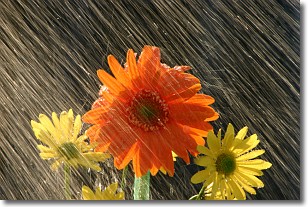
Precipitation can refer to many different forms of water that
may fall from clouds. Precipitation occurs after a cloud has become saturated to
the point where its water particles are more dense than the air below the cloud.
In most cases, precipitation will reach the ground, but it is not uncommon for
precipitation to evaporate before it reaches the earth's surface.
When precipitation evaporates before it contacts the ground it is called Virga.
Graupel, hail, sleet, rain, drizzle, and snow are forms of precipitation, but fog
and mist are not considered precipitation because the water vapor which
constitutes them isn't dense enough to fall to the ground.
Next Topic: Rain
Weather Topic: What are Shelf Clouds?
Home - Education - Cloud Types - Shelf Clouds
 Next Topic: Sleet
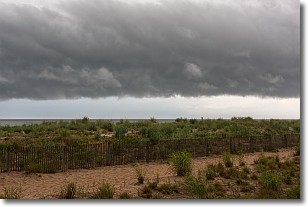
A shelf cloud is similar to a wall cloud, but forms at the front
of a storm cloud, instead of at the rear, where wall clouds form.
A shelf cloud is caused by a series of events set into motion by the advancing
storm; first, cool air settles along the ground where precipitation has just fallen.
As the cool air is brought in, the warmer air is displaced, and rises above it,
because it is less dense. When the warmer air reaches the bottom of the storm cloud,
it begins to cool again, and the resulting condensation is a visible shelf cloud.
Next Topic: Sleet
Current conditions powered by WeatherAPI.com