Weather Alert in New York
Coastal Flood Advisory issued February 22 at 3:22PM EST until February 23 at 6:00PM EST by NWS Upton NY
AREAS AFFECTED: Southwest Suffolk; Southern Nassau
DESCRIPTION: * WHAT...For the Coastal Flood Warning, 1 1/2 to 2 1/2 ft, locally 3 ft, of inundation above ground level expected in vulnerable areas near the waterfront and shoreline. For the Coastal Flood Advisory, up to 1 1/2 ft of inundation above ground level expected in vulnerable areas near the waterfront and shoreline. * WHERE...Southwest Suffolk and Southern Nassau Counties. * WHEN...For the Coastal Flood Warning, from 10 PM this evening to 4 AM EST Monday. For the Coastal Flood Advisory, from 11 AM to 6 PM EST Monday. * COASTAL FLOOD IMPACTS...Widespread moderate to localized major flooding of vulnerable areas near the waterfront and shoreline likely. Expect 1 1/2 to 2 1/2 ft, locally 3 ft of inundation above ground level possible in low lying, vulnerable areas. This will result in numerous road closures and cause widespread flooding of low lying property including parking lots, parks, lawns and homes/businesses with basements near the waterfront. Vehicles parked in vulnerable areas near the waterfront will likely become flooded. Flooding will also extend inland from the waterfront along tidal rivers and bays. Ice cover in the bays and harbors could exacerbate flooding and cause damage to northeast to east facing shoreline structures. * SHORELINE IMPACTS...Breaking surf of 5 to 10 ft along the ocean front will cause widespread beach flooding and erosion during the time of high tide. Areas of dune erosion are likely, with localized washovers possible where dunes are compromised. * ADDITIONAL DETAILS...This water level forecast has been leaned towards a high end scenario, providing a margin of safety. It is highly dependent on timing of windshift from northeast to north storm force winds with respect to the time of high tide. If shift to northerly winds occurs earlier than time of high tide, water levels will fall to the low end or even below the forecast range. Ice cover in the bays and harbors could exacerbate flooding and cause damage to north to northeast facing shoreline structures. Additional minor to locally moderate coastal flooding is likely with the Monday afternoon high tide.
INSTRUCTION: Take the necessary actions to protect flood-prone property. If travel is required, do not drive around barricades or through water of unknown depth.
Want more detail? Get the Complete 7 Day and Night Detailed Forecast!
Current U.S. National Radar--Current
The Current National Weather Radar is shown below with a UTC Time (subtract 5 hours from UTC to get Eastern Time).

National Weather Forecast--Current
The Current National Weather Forecast and National Weather Map are shown below.

National Weather Forecast for Tomorrow
Tomorrow National Weather Forecast and Tomorrow National Weather Map are show below.

North America Water Vapor (Moisture)
This map shows recent moisture content over North America. Bright and colored areas show high moisture (ie, clouds); brown indicates very little moisture present; black indicates no moisture.

Weather Topic: What is Sleet?
Home - Education - Precipitation - Sleet
 Next Topic: Snow
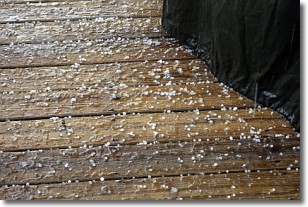
Sleet is a form of precipitation in which small ice pellets are the primary
components. These ice pellets are smaller and more translucent than hailstones,
and harder than graupel. Sleet is caused by specific atmospheric conditions and
therefore typically doesn't last for extended periods of time.
The condition which leads to sleet formation requires a warmer body of air to be
wedged in between two sub-freezing bodies of air. When snow falls through a warmer
layer of air it melts, and as it falls through the next sub-freezing body of air
it freezes again, forming ice pellets known as sleet. In some cases, water
droplets don't have time to freeze before reaching the surface and the result is
freezing rain.
Next Topic: Snow
Weather Topic: What are Stratocumulus Clouds?
Home - Education - Cloud Types - Stratocumulus Clouds
 Next Topic: Stratus Clouds
Stratocumulus clouds are similar to altocumulus clouds in their
fluffy appearance, but have a slightly darker shade due to their additional mass.
A good way to distinguish the two cloud types is to hold your hand out and measure
the size of an individual cloud; if it is the size of your thumb it is generally
an altocumulus cloud, if it is the size of your hand it is generally a
stratocumulus cloud.
It is uncommon for stratocumulus clouds to produce precipitation, but if they do
it is usually a light rain or snow.
Next Topic: Stratus Clouds
Current conditions powered by WeatherAPI.com